2026.09.08
Watching a Massive Binary Assemble in Real Time
Many stars in the Milky Way Galaxy are born not alone, but in pairs. In fact, the most massive stars are especially likely to have stellar companions. These massive binary systems play important roles throughout the Universe, influencing how stars evolve and enriching space with heavy elements. Yet astronomers still do not fully understand how close massive binaries are assembled. Most known massive binaries are observed long after their formation has ended, making it difficult to reconstruct the processes that created them.
To address this question, an international team of astronomers led by Yichen Zhang of Shanghai Jiao Tong University studied a remarkable object known as IRAS 07299−1651. This system contains two massive protostars, stars that are still actively growing by accreting material from their surroundings. In an earlier ALMA study, the same team identified the system as one of the first deeply embedded massive protobinaries with direct dynamical constraints. At the time, the results appeared broadly consistent with the traditional picture in which a close binary forms when a massive gas disk fragments into two stars. However, one important clue did not fit neatly into that scenario: the disks around the two young stars appeared to be misaligned.
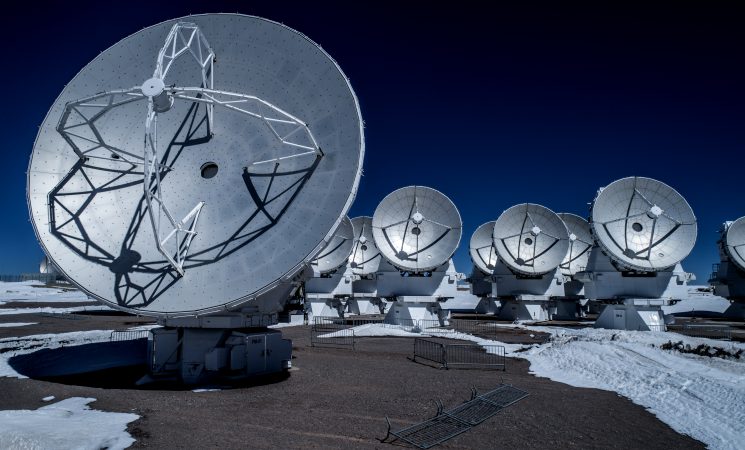
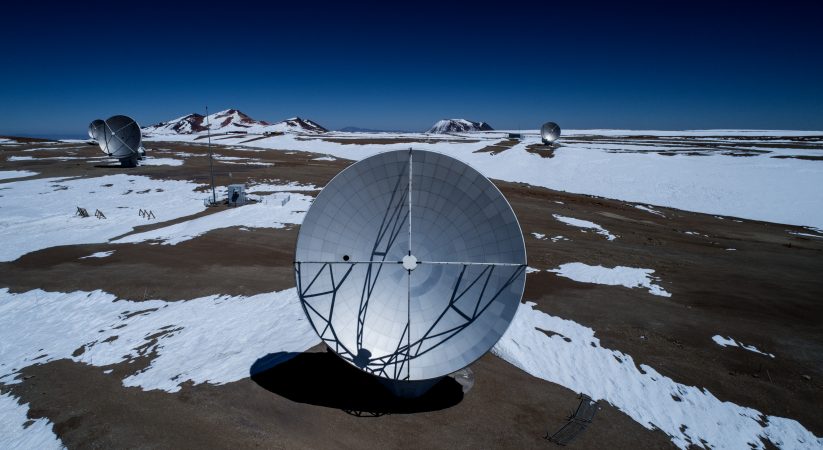
To investigate further, the team launched a long-term observing campaign to measure the tiny proper motions of the two stars. Detecting such changes requires exceptional angular resolution and positional accuracy. ALMA was uniquely suited to this task. By combining observations obtained over nearly eight years, the researchers measured subtle positional shifts that revealed the stars’ orbital motion. “For the first time, we were able to watch two massive stars move around one another while they were still being born,” said Yichen Zhang, the corresponding author of the study.
The team then combined these ALMA data with observations from the Karl G. Jansky Very Large Array (VLA), the James Webb Space Telescope (JWST), and the European Southern Observatory’s Very Large Telescope (VLT). Together, these facilities provided one of the most complete views ever obtained of a forming massive binary system. Across the multi-band observations, strong constraints were also provided on the masses of the forming stars and their other properties, which are vital for the orbital reconstruction. “Each telescope revealed a different piece of the puzzle,” said Ruben Fedriani, a co-author of the paper. “The combination of radio and infrared observations provides the most exquisite detail on the formation of this massive protobinary system.”
The observations allowed the researchers to reconstruct the system’s full three-dimensional architecture. Besides reconstructing the binary orbit, ALMA also resolved the compact circumstellar disks around the two forming stars, placing strong constraints on their stellar properties, disk orientations, and gas kinematics, while JWST observations traced the directions of jets launched from the system. This view revealed two surprising results. First, the orbit is highly eccentric, meaning the stars travel along a stretched-out path rather than a nearly circular one. Second, the disks around the two stars are strongly misaligned with each other and with their orbital planes. “It felt like solving a three-dimensional puzzle. Each new observation added another piece, and eventually the orbit, disks, and jets all came together into a single, coherent picture,” said Yao Wang, the first author of the paper.
These properties are difficult to explain if both stars formed together through the fragmentation of a single disk. In that commonly accepted picture, the stars and their disks would generally be expected to share similar orientations and relatively orderly motions. Instead, the newly measured three-dimensional structure points toward a different history. The discovery reveals a previously unconfirmed pathway for forming close massive binary systems. The observations suggest that the two stars began forming independently and later became gravitationally bound through a close encounter while they were still embedded in their natal cloud. In essence, rather than growing up together, the two young stars appear to have met and become partners during their formation. “This study demonstrates that the early lives of stars can be quite chaotic, with a chance encounter leading to this gravitational dance and stellar coupling,” said Jonathan C Tan, a co-author of the paper.
The study also demonstrates a powerful new observational approach. Previously, astronomers studying forming massive binaries were largely limited to measuring projected separations on the sky and, in a few cases, radial velocity differences. Reconstructing the full three-dimensional structure of an embedded massive binary system remained beyond reach. This work shows that such measurements are now possible through long-term, high-precision observations.
Future observations of IRAS 07299−1651 will further refine the orbital measurements. More importantly, by applying the same technique to a larger sample of young massive binaries, astronomers will be able to determine how common this newly identified formation pathway may be and gain a clearer understanding of how the most massive stars in the Universe are assembled. The study opens a new observational window onto one of astronomy’s longstanding mysteries: the birth of massive binary stars.

Figure1: The inset circle shows ALMA 0.9 mm continuum image of the central binary system of IRAS 07299−1651 with the reconstructed orbital trajectories overlaid. The red- and blue-shifted hydrogen recombination line emission traces the rotation of the ionized circumstellar disks around the two forming stars, while the arrows indicate the directions of the bipolar jets. Background: Mid-infrared image of the region obtained with JWST (red = F470N, green = F405N, blue = F360M). (Credit: NASA, ESA, CSA, STScI, Joseph DePasquale (STScI), ALMA (ESO/NAOJ/NRAO), Yichen Zhang)
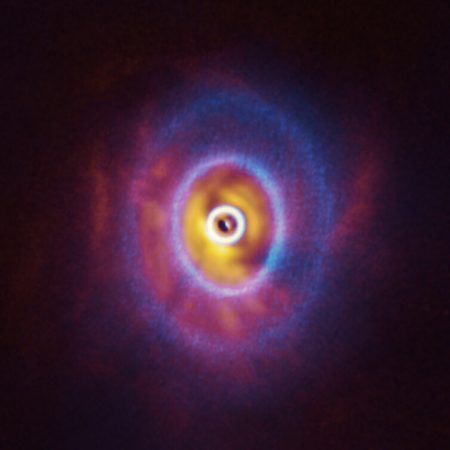
Figure 2: An artist’s impression of the formation of a close massive binary system, showing misaligned disks around two young stars. (Credit: Yichen Zhang)
This research was published in a paper titled “An eccentric massive protobinary assembled via a core-merger parabolic encounter” by Yao Wang et al. published in Nature Astronomy on 7 September, 2026.
DOI: 10.1038/s41550-026-02953-z
– Yichen Zhang – Associate Professor at Shanghai Jiao Tong University
– Yao Wang – Ph.D. student at Shanghai Jiao Tong University
– Ruben Fedriani – Astronomer at the Instituto de Astrofísica de Andalucía (IAA-CSIC)
– Jonathan C. Tan – Professor at Chalmers University of Technology and the University of Virginia
Related link
•Spiraling giants: witnessing the birth of a massive binary star system (2019.03.28 ALMA Press Release)
The Atacama Large Millimeter/submillimeter Array (ALMA), an international astronomy facility, is a partnership of the European Organization for Astronomical Research in the Southern Hemisphere (ESO), the U.S. National Science Foundation (NSF) and the National Institutes of Natural Sciences (NINS) of Japan in cooperation with the Republic of Chile. ALMA is funded by ESO on behalf of its Member States, by NSF in cooperation with the National Research Council of Canada (NRC) and the National Science and Technology Council (NSTC) in Taiwan and by NINS in cooperation with the Academia Sinica (AS) in Taiwan and the Korea Astronomy and Space Science Institute (KASI).
ALMA construction and operations are led by ESO on behalf of its Member States; by the National Radio Astronomy Observatory (NRAO), managed by Associated Universities, Inc. (AUI), on behalf of North America; and by the National Astronomical Observatory of Japan (NAOJ) on behalf of East Asia. The Joint ALMA Observatory (JAO) provides the unified leadership and management of the construction, commissioning, and operation of ALMA.