2026.11.05
Uncovering Hidden Views of the Universe: PRIISM, an Imaging Tool for ALMA
The Atacama Large Millimeter/submillimeter Array (ALMA) is a radio interferometer that combines signals received by many antennas so that they function as a single giant telescope. However, observations do not directly produce images of astronomical objects. Instead, they measure only part of the information on how the object’s emission is distributed in space. Astronomers must therefore turn these incomplete measurements into a picture, a process called “imaging.” In radio astronomy, a technique called CLEAN, developed about 50 years ago, is still the standard method today.
PRIISM [1,2] is a software package developed by researchers in Japan. It applies “sparse modeling,” an approach from statistics that extracts essential structures from limited information, to astronomical imaging. Under the condition that the reconstructed image must agree with the observational data, PRIISM searches for the most probable image by assuming that “the true image contains as little unnecessary structure as possible and varies smoothly.” Constructing an image requires several adjustable parameters, and PRIISM is designed to determine them automatically by evaluating their consistency with the data. As a result, the outcome does not depend on who performs the analysis. PRIISM works together with ALMA’s standard data-analysis software and is available as open-source software.
In the CLEAN method, the final image must undergo an intentional smoothing step. As a consequence, fine structures contained in the data become blurred. PRIISM does not use this step; instead, it directly searches for the image that best matches the observations, allowing finer substructures to be recovered from the same dataset (see figure). In other words, PRIISM can reveal information that was already present in the data, without requiring new observations.
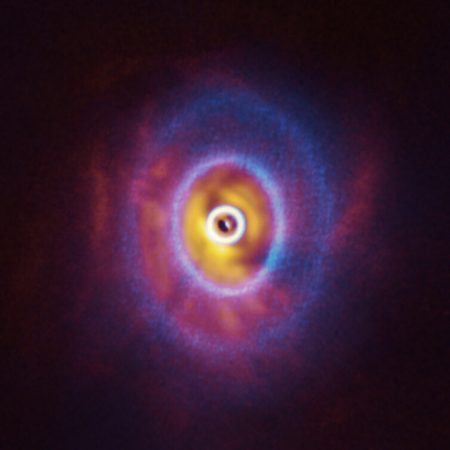
PRIISM has been particularly successful in studies of protoplanetary disks, the disks of gas and dust surrounding newly formed stars. Planets are born within these disks. As forming planets grow, they are thought to carve gaps in the surrounding dust; therefore, rings and gaps in a disk provide valuable signposts of planet formation.
In a systematic survey of ALMA archival data, researchers identified 24 rings and gaps in 43 disks in the Taurus star-forming region, half of which were detected for the first time with PRIISM [3]. The relation between the widths and depths of the gaps is also consistent with models in which planets create the gaps [3]. A study of 78 disks in the Ophiuchus star-forming region further revealed that such structures begin to appear as early as a few hundred thousand years after the birth of their host stars [4,5]. Detailed studies of individual systems have also uncovered new structures in disks in a wide variety of environments, including multiple-star systems, a system hosting a very young planet, and stars that undergo dramatic outbursts in brightness [6-10].
PRIISM is still under active development. A new function, “PRIISM-selfcal”, that performs calibration and imaging simultaneously has recently been released [11]. The developers are also working to extend PRIISM to three-dimensional datasets that trace the motion of molecular gas, and to apply it to objects beyond protoplanetary disks, such as galaxies. Applying new analysis techniques such as PRIISM to ALMA’s vast archive of data is expected to further expand the scientific output of ALMA.

Images of 125 protoplanetary disks in the Taurus and Ophiuchus star-forming regions, created from ALMA archival data. The animation alternates between images produced using the conventional CLEAN method and those reconstructed with PRIISM. Fine substructures such as rings and gaps appear more clearly in the PRIISM images, despite being derived from the same observational data. (Credit: PRIISM Development Team)
A side-by-side comparison image is also available.
Related Links
•“PRIISM: Imaging Tool for ALMA” (Topics in 2026 August issue of The Astronomical Herald, the monthly publication of the Astronomical Society of Japan)
»Overview of PRIISM: An Imaging Tool for the ALMA Telescope
»PRIISM Science: Probing Substructures in Protoplanetary Disks
»The Future Prospects of the ALMA Imaging Tool PRIISM
•Software Repositories (GitHub)
»PRIISM:https://github.com/tnakazato/priism
»PRIISM-selfcal:https://github.com/ikeda46/priism-selfcal
Reference
[1]Nakazato, T., & Ikeda, S. 2020, PRIISM: Python module for Radio Interferometry Imaging with Sparse Modeling, Astrophysics Source Code Library, ascl:2006.002
https://ascl.net/2006.002
[2]Nakazato, T., Ikeda, S., Kosugi, G., & Honma, M. 2020, SPIE, 11453, 114532V
https://ui.adsabs.harvard.edu/abs/2020SPIE11453E..2VN/abstract
[3] Yamaguchi, M., Muto, T., Tsukagoshi, T., et al. 2024, PASJ, 76, 437. ALMA 2D super-resolution imaging of Taurus–Auriga protoplanetary disks: Probing statistical properties of disk substructures.
https://academic.oup.com/pasj/article/76/3/437/7675749
[4] Shoshi, A., Yamaguchi, M., Muto, T., et al. 2025, PASJ, 77, 572. ALMA 2D super-resolution imaging survey of Ophiuchus Class I/flat spectrum/II disks. I. Discovery of new disk substructures.
https://academic.oup.com/pasj/article/77/3/572/8117664
[5] Shoshi, A., Yamaguchi, M., Muto, T., et al. 2026, PASJ, published. ALMA 2D super-resolution imaging survey of Ophiuchus Class I/flat spectrum/II disks. II. Statistical analysis of stellar and disk properties
https://doi.org/10.1093/pasj/psag087
[6] Yamaguchi, M., Tsukagoshi, T., Muto, T., et al. 2021, ApJ, 923, 121. ALMA Super-resolution Imaging of T Tau: r = 12 au Gap in the Compact Dust Disk around T Tau N
https://doi.org/10.3847/1538-4357/ac2bfd
[7] Shoshi, A., Muto, T., Bosschaart, Q., et al. 2025, ApJ, 993, 90. ALMA High-resolution Observation for the Transitional Disk Around IRAS 04125+2902
https://iopscience.iop.org/article/10.3847/1538-4357/ae045a
[8] Shoshi, A., Yamaguchi, M., Omura, M., et al. 2026, ApJ, 998, 214. Ring-gap Structures in the Class I Circumstellar Disk of CrA IRS 2 Associated with the Magnetic Flux-driven Bubble.
https://iopscience.iop.org/article/10.3847/1538-4357/ae394a
[9] Yamaguchi, M., Liu, H. B., Takami, M., & Gu, P.-G. 2025, ApJ, 993, 85. Peculiar Disk Substructures Associated with the Young Eruptive Star EX Lupi.
https://iopscience.iop.org/article/10.3847/1538-4357/adff50
[10] Yamaguchi, M., Machida, M. N., Tominaga, R. T., et al. 2026, ApJ, 1006, 232. A Hybrid Origin for the Multiple Ring-gap Structures in the Large Protoplanetary Disk V1094 Sco: A Low-mass Planet and Secular Gravitational Instability
https://iopscience.iop.org/article/10.3847/1538-4357/ae819b
[11] Ikeda, S., Nakazato, T., Tsukagoshi, T., Takeuchi, T. T., & Yamaguchi, M. 2025, PASJ, 77, 260. Solving self-calibration of ALMA data with an optimization method
https://academic.oup.com/pasj/article/77/2/260/8015543
About ALMA
The Atacama Large Millimeter/submillimeter Array (ALMA), an international astronomy facility, is a partnership of the European Organization for Astronomical Research in the Southern Hemisphere (ESO), the U.S. National Science Foundation (NSF) and the National Institutes of Natural Sciences (NINS) of Japan in cooperation with the Republic of Chile. ALMA is funded by ESO on behalf of its Member States, by NSF in cooperation with the National Research Council of Canada (NRC) and the National Science and Technology Council (NSTC) in Taiwan and by NINS in cooperation with the Academia Sinica (AS) in Taiwan and the Korea Astronomy and Space Science Institute (KASI).
ALMA construction and operations are led by ESO on behalf of its Member States; by the National Radio Astronomy Observatory (NRAO), managed by Associated Universities, Inc. (AUI), on behalf of North America; and by the National Astronomical Observatory of Japan (NAOJ) on behalf of East Asia. The Joint ALMA Observatory (JAO) provides the unified leadership and management of the construction, commissioning, and operation of ALMA.