2026.01.08
Multiple Origins Behind The Extreme Star Formation In “Monster Galaxies”
In the early Universe, roughly 10 to 12 billion years ago, some galaxies were deeply buried in dust and forming stars at rates hundreds of times faster than the Milky Way. These galaxies, commonly referred to as “monster galaxies,” are believed to be the ancestors of the massive galaxies seen in the present-day Universe.
Although monster galaxies are thought to have grown rapidly by forming stars within a very short period after the birth of the Universe, the physical processes driving such extreme star formation have long remained a mystery in studies of galaxy formation and evolution.
Until recently, “spontaneous” star formation driven by internal processes was widely considered the primary explanation. However, monster galaxies lie at vast distances, and previous observations lacked the spatial resolution needed to reveal their internal structures in detail. Furthermore, observations capable of comparing multiple wavelengths — and thus different physical components — at similarly high resolution have been extremely limited (for example, refer to the research news from Nagoya University), making it difficult to directly identify the origins of their star formation.
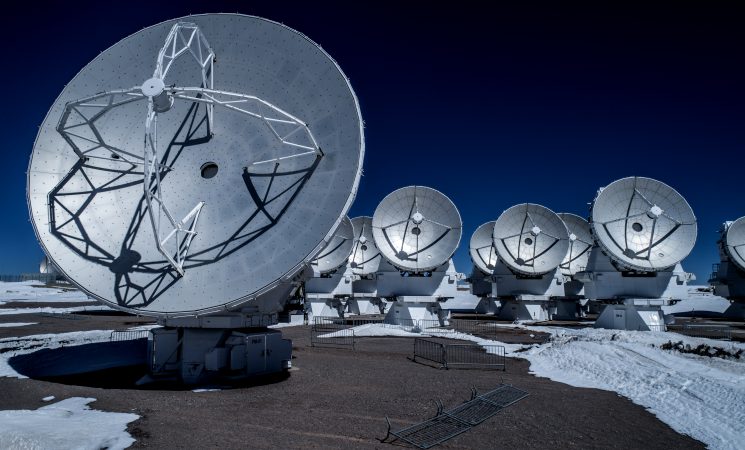
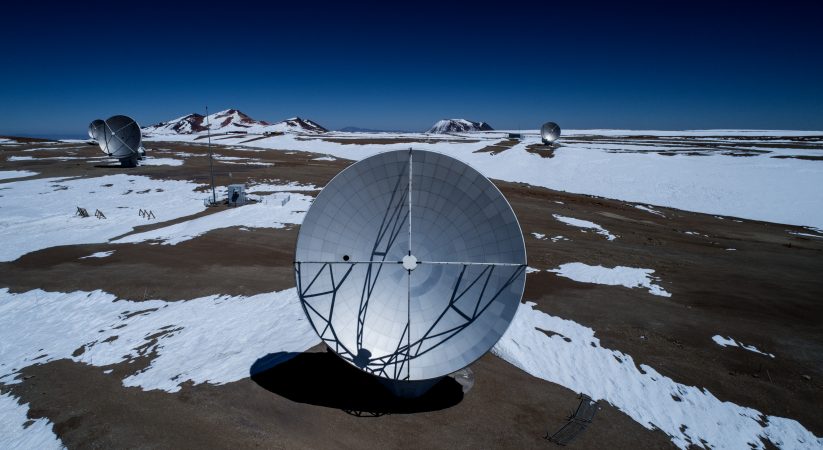
An international research team led by Ryota Ikeda and Daisuke Iono of the Graduate University for Advanced Studies (SOKENDAI) and the National Astronomical Observatory of Japan, together with Ken-ichi Tadaki of Hokkai-Gakuen University, has conducted detailed observations of three monster galaxies located in the direction of the constellation Sextans. Using the Atacama Large Millimeter/submillimeter Array (ALMA) and the James Webb Space Telescope (JWST), the team has revealed that the same monster galaxy can appear strikingly different depending on the telescope used.
In this study, the research team has leveraged the exceptionally high spatial resolution of ALMA and JWST to directly compare, at matched resolution, the distributions of ongoing star formation and stellar populations in three monster galaxies: AzTEC-1, AzTEC-4, and AzTEC-8. ALMA is particularly sensitive to star formation hidden by dust, while JWST excels in tracing stellar distributions at wavelengths less affected by dust obscuration. By observing these monster galaxies with an exceptionally high angular resolution of 0.06 arcseconds — equivalent to visual acuity of 1000 — the team achieved an unprecedented, direct examination of the physical origins of star formation in monster galaxies.
The analysis revealed for the first time that the spatial distributions of star formation and stars differ significantly among the three galaxies (Figures 1 and 2). A closer investigation shows that three distinct processes can each trigger the intense star formation seen in monster galaxies: (1) major collisions between two large galaxies (AzTEC-1), (2) spontaneous star formation driven by internal gravitational instability (AzTEC-4), and (3) collisions with smaller companion galaxies (AzTEC-8) (see Footnote).
These results strongly indicate that the rapid growth of massive galaxies is not governed by a single pathway, but instead involves multiple physical mechanisms.
Lead author Ryota Ikeda comments, “When we first saw the multi-wavelength images of these monster galaxies, we were truly surprised by their diversity. By combining the power of ALMA and JWST, we are delighted to have taken an important step toward resolving a long-standing mystery in galaxy evolution.”
Looking ahead, the team plans to significantly expand the sample of observed galaxies, conduct statistical tests on the diversity of massive galaxy formation, and further explore the origins of galaxies — including our own Milky Way.
Images

Figure 1: (Top) Observed images from two high-resolution telescopes, showing the distributions of star formation traced by ALMA (blue) and stellar emission traced by the JWST (red). (Bottom) Schematic illustrations corresponding to each observation. (Credit: NAOJ)
Figure 2: Schematic view of AzTEC-8 as seen by ALMA and JWST. By contrasting the different components traced by ALMA and JWST, the “two faces” of this monster galaxy are revealed. (Credit: NAOJ)
Footnote:
Characteristics of Each Galaxy
AzTEC-1
Star formation is widespread across the galaxy, while the stellar distribution is strongly concentrated toward the center. This suggests that a major merger between large galaxies funneled gas inward while also spreading it throughout the system, leading to intense central star formation. In this case, a galaxy collision likely acted as the trigger for star formation.
AzTEC-4
ALMA observations reveal a spiral structure with two prominent arms, whereas JWST shows a relatively smooth, disk-like stellar distribution without strong spiral features. Such a configuration is difficult to explain through a major merger and instead points to spontaneous star formation driven by internal gravitational instability.
AzTEC-8
ALMA detects compact star formation concentrated near the galaxy center, while JWST reveals a much more extended stellar distribution accompanied by multiple massive stellar clumps. This structure suggests that a collision with a smaller companion galaxy may have triggered the starburst.
Publication
This research has been published in The Astrophysical Journal as
Ikeda et al., “Formation of Substructure in Luminous Submillimeter Galaxies (FOSSILS): Evidence of Multiple Pathways to Trigger Starbursts in Luminous Submillimeter Galaxies,” on Jan 8, 2026
DOI: 10.3847/1538-4357/ae157e
Research Team
Ryota Ikeda¹,², Daisuke Iono¹,², Kenichi Tadaki³, Maximilien Franco⁴, Min S. Yun⁵, Jorge A. Zavala⁵, Yoichi Tamura⁶, Takafumi Tsukui⁷, Christina C. Williams⁸, Bunyo Hatsukade1,2,9, Minju Lee¹⁰, Tomonari Michiyama¹¹, Ikki Mitsuhashi¹,², Kouichiro Nakanishi¹,², Caitlin M. Casey¹³, Soh Ikarashi¹⁴, Kianhong Lee⁶, Yuichi Matsuda¹,², Toshiki Saito¹⁵, Andrea Silva², Hideki Umehata⁶, Hidenobu Yajima¹⁶
¹ The Graduate University for Advanced Studies (SOKENDAI) ² National Astronomical Observatory of Japan ³ Hokkai-Gakuen University ⁴ Université de Paris ⁵ University of Massachusetts ⁶ Nagoya University ⁷ Tohoku University ⁸ NSF NOIRLab ⁹ University of Tokyo ¹⁰ University of Copenhagen ¹¹ Shunan Public University ¹² University of Colorado ¹³ University of California, Santa Barbara ¹⁴ Fukuoka Institute of Technology ¹⁵ Shizuoka University ¹⁶ University of Tsukuba
Support
This research was supported by JSPS KAKENHI (Numbers 23KJ1006, 23K20870, 22H04939, 23K20035, 24H00004, 25K17441), and Marie Skłodowska-Curie grant agreement (No.101148925, No.101107795).
The Atacama Large Millimeter/submillimeter Array (ALMA), an international astronomy facility, is a partnership of the European Organisation for Astronomical Research in the Southern Hemisphere (ESO), the U.S. National Science Foundation (NSF) and the National Institutes of Natural Sciences (NINS) of Japan in cooperation with the Republic of Chile. ALMA is funded by ESO on behalf of its Member States, by NSF in cooperation with the National Research Council of Canada (NRC) and the National Science and Technology Council (NSTC) in Taiwan and by NINS in cooperation with the Academia Sinica (AS) in Taiwan and the Korea Astronomy and Space Science Institute (KASI).
ALMA construction and operations are led by ESO on behalf of its Member States; by the National Radio Astronomy Observatory (NRAO), managed by Associated Universities, Inc. (AUI), on behalf of North America; and by the National Astronomical Observatory of Japan (NAOJ) on behalf of East Asia. The Joint ALMA Observatory (JAO) provides the unified leadership and management of the construction, commissioning and operation of ALMA.