2026.03.06
Largest image of its kind shows hidden chemistry at the heart of the Milky Way
The innermost zone of the Milky Way Galaxy harbors dense clouds of gas and dust. This region, so-called the ‘Central Molecular Zone’ (CMZ), where star formation is active and massive stars born will end in powerful supernova explosions, is an exceptionally energetic environment in the Milky Way.
Every galaxy possesses a CMZ, but the Milky Way’s CMZ is the nearest and most accessible laboratory for studying star formation in the deepest gravitational potential, particularly in the vicinity of the supermassive black hole, Sgr A*. ACES — the ALMA CMZ Exploration Survey derived the distribution of cold gas spanning more than 650 light-years in the CMZ with unprecedented detail.
“It offers a unique opportunity to observe high spatial resolution structures and explore rich physical and chemical environments that reveal the history of Sgr A* activity, bursts of massive star formation, and the feedback processes that shape the life cycle of interstellar gas,” says Pei-Ying Hsieh, an Assistant Professor of the National Astronomical Observatory of Japan, who joins ACES. For example, gas inflows can trigger intense star formation or enhanced Sgr A* activity, while the subsequent energy feedback generates outflows or bubbles that disrupt further accretion.
The mosaic image obtained by stitching together many individual observation fields as long as three full Moons side-by-side in the sky is, in fact, the largest ALMA image ever.
“This study presents the first high–angular–resolution, large–scale mosaic of the CMZ, a task that would be nearly impossible for other interferometers to accomplish within a reasonable timeframe.” For comparison, an equivalent survey could take several years with other facilities, whereas the ALMA 12-m array completed it in only ~150 hours.
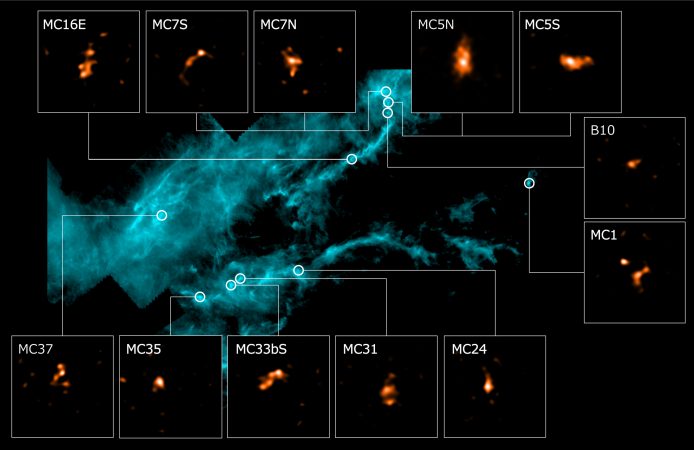
The wide instantaneous bandwidth of ALMA also enables simultaneous imaging of numerous spectral lines. ACES specifically explores cold molecular gas as the raw material from which stars form. The survey unpacks the intricate chemistry of the CMZ, detecting dozens of different molecules, from simple ones such as silicon monoxide to more complex organic ones like methanol, acetone, or ethanol. The wide-field imaging provides uniform coverage of diverse physical environments across the CMZ, enabling homogeneous comparisons of the physical and chemical conditions of the molecular gas.
With high fidelity and a wide dynamic range which ALMA provided, it is remarkable to see molecular gas structures revealed across a wide range of spatial scales simultaneously, from large filamentary structures dozens of light-years across to small gas clouds surrounding individual stars. “The ACES images are striking: what once appeared as smooth, diffuse clouds are now resolved into intricate, multi-scale structures, revealing the true complexity of the molecular gas in the CMZ.”
Cold molecular gas flows along filaments feeding into clumps of matter out of which stars can grow. This process is known in the outskirts of the Milky Way, where star formation activity is relatively calm, but whether our theories of star formation hold within the gas cloud in CMZ, where violent star formations or supernovae influence. Furthermore, this region may share many features with extreme environments within galaxies that formed stars chaotically in the early Universe.
One of the major advantages of the ACES data being released is the simultaneous availability of numerous spectral lines and continuum images for many astronomers. Moreover, the dataset will help identify the most effective molecular tracers for different types of sources, providing a valuable reference for planning future observations. It is not only of the Galactic Center but also of external galaxies—particularly in preparation for the ALMA upcoming Wideband Sensitivity Upgrade (WSU).
“I expect that these data will not only lead to many observational studies but also stimulate theoretical and simulation work to understand gas dynamics, physical and chemical conditions, and overall Galactic dynamics” Pei-Ying states.
This research was presented in a series of papers presenting the ACES data, to appear in Monthly Notices of the Royal Astronomical Society on October 15, 2025.
ACES, the ALMA CMZ Exploration Survey, is a “Large Program” survey of the ‘Central Molecular Zone’ (CMZ) – the inner-100 pc (300 light-years) of the Milky Way Galaxy – with the ALMA telescope. ACES will derive the properties of all potentially star-forming gas in the Galactic Centre, from global (100 pc) to proto-stellar core (0.05 pc) scales, down to sub-sonic (<0.4 km/s) velocity resolution. ACES’ primary goal is to determine how global processes set the location, intensity, and timescales for SF/FB in the Galactic Centre.
ACES is a consortium of the Galactic Center researchers’ community, especially those who are involved in CMZ research. The international ACES team is composed of over 160 scientists working at more than 70 institutions across Europe, North and South America, Asia, and Australia.
Pei-Ying Hsieh, an Assistant Professor of the National Astronomical Observatory of Japan, joins the ALMA data reduction working group within ACES.
The Atacama Large Millimeter/submillimeter Array (ALMA), an international astronomy facility, is a partnership of the European Organisation for Astronomical Research in the Southern Hemisphere (ESO), the U.S. National Science Foundation (NSF) and the National Institutes of Natural Sciences (NINS) of Japan in cooperation with the Republic of Chile. ALMA is funded by ESO on behalf of its Member States, by NSF in cooperation with the National Research Council of Canada (NRC) and the National Science and Technology Council (NSTC) in Taiwan and by NINS in cooperation with the Academia Sinica (AS) in Taiwan and the Korea Astronomy and Space Science Institute (KASI).
ALMA construction and operations are led by ESO on behalf of its Member States; by the National Radio Astronomy Observatory (NRAO), managed by Associated Universities, Inc. (AUI), on behalf of North America; and by the National Astronomical Observatory of Japan (NAOJ) on behalf of East Asia. The Joint ALMA Observatory (JAO) provides the unified leadership and management of the construction, commissioning and operation of ALMA.

Figure 1: The Central Molecular Zone (CMZ) of the Milky Way observed with ALMA. Note that the sharp edge of gas distribution implicates the border of the data, because the ALMA observations do not cover the entire rectangular area. This is a composite image of five molecular species in different colors: sulphur monoxide (cyan), silicon monoxide (green), isocyanic acid (red), cyanoacetylene (blue), and carbon monosulphide (magenta). The stars in the foreground were observed at infrared wavelengths. (Credit: ALMA(ESO/NAOJ/NRAO)/S. Longmore et al. Background: ESO/D. Minniti et al.)
Figure 2: The ALMA CMZ Exploration Survey (ACES) has mapped the distribution of several dozen molecules. This montage shows five of them, from top to bottom: carbon monosulphide, isocyanic acid, silicon monoxide, sulphur monoxide, and cyanoacetylene. (Credit: ALMA(ESO/NAOJ/NRAO)/S. Longmore et al.)
Figure 3: The location of the Central Molecular Zone (CMZ). Dense and intricate gas clouds are harbored at the core of the Milky Way Galaxy. The inset of an ACES image is as long as three full Moons side-by-side in the sky, and it is in fact the largest ever made with ALMA. (Credit: ALMA(ESO/NAOJ/NRAO)/S. Longmore et al. Stars in inset: ESO/D. Minniti et al. Milky Way: ESO/S. Guisard)