
(Image Courtesy of Chiba University)
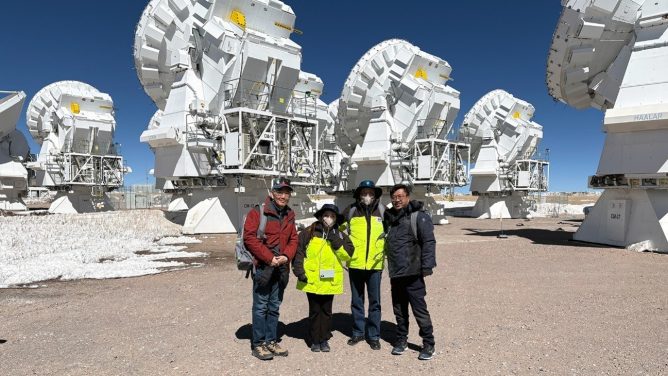
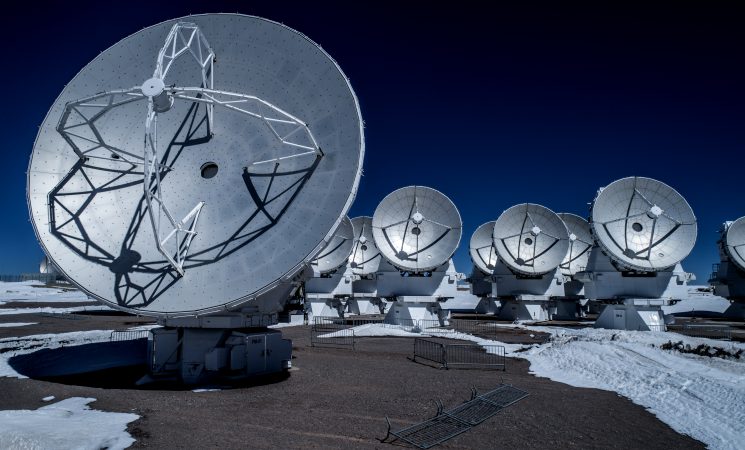
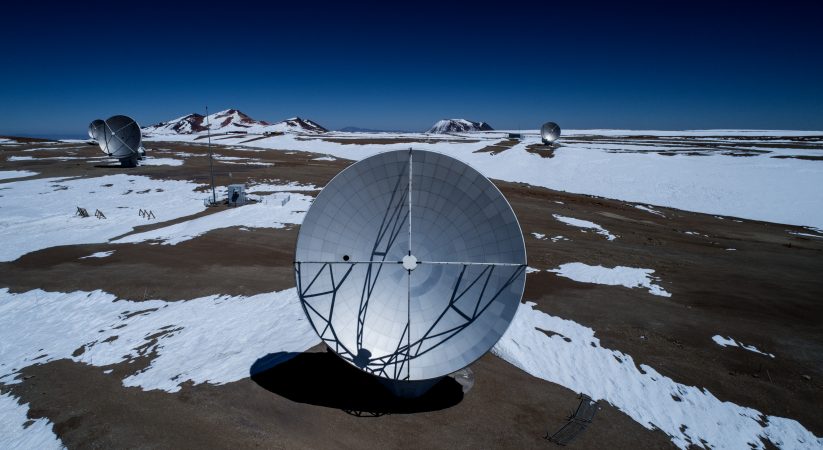
Yoshinobu Fudamoto, Assistant Professor at Chiba University, received the award for his work entitled “Observational Study of Various Physical Properties of Distant Galaxies.” Fudamoto has been studying the formation and evolution of galaxies, focusing on how galaxies emerged and developed in the early universe. He conducts observations of high‑redshift galaxies using the Atacama Large Millimeter/submillimeter Array (ALMA) and the James Webb Space Telescope (JWST), and seeks to understand their origins by comparing observational data with theoretical models.
In his 2021 study, “Unveiling Galaxies at Cosmic Dawn That Were Hiding Behind the Dust,” Fudamoto discovered distant galaxies that are deeply embedded in dust and therefore invisible to optical telescopes such as the Subaru Telescope. This discovery was made using large survey datasets obtained with ALMA. At the time of this research, Fudamoto was a Project Researcher working on the ALMA Project at the National Astronomical Observatory of Japan (NAOJ).
Reflecting on the award, Fudamoto commented:
“I am deeply honored to receive this prestigious award. This recognition is owed entirely to my collaborators and to everyone involved in the ALMA telescope. Looking back, ALMA’s Cycle 0 observations began right around the time I was about to enter the master’s course, and ever since then, each new round of observations has brought an unbroken stream of major discoveries.
In 2021, while examining data from a large ALMA survey, I discovered ‘dust-obscured galaxies in the very early Universe’, that cannot be observed or identified even with the Hubble Space Telescope. This finding was a complete surprise to me. The experience taught me how important it is to look at observational data carefully and directly, free from preconceptions, and to be receptive to what nature, the Universe far beyond our imagination, allows us to glimpse.
In recent years, with the arrival of the James Webb Space Telescope, the scope of ALMA’s contributions has expanded enormously, and major upgrades to ALMA are also on the horizon. I am thrilled at the prospect that each time ALMA ventures into a new observational frontier, it will open yet another door for us. In order to share the excitement I have gained through my observations and research, I look forward to continuing to push forward the frontiers of astronomy together with all my colleagues at ALMA and throughout the broader astronomical community.”