2026.04.15
Unveiling the Mystery of Protoplanetary Disk Formation Around Young Stars
(This result is released from ASIAA on April 15, 2026.)
Protoplanetary disks form around young stars when dense molecular cloud cores collapse under their own gravity. An outer shroud of gas and dust, known as the “envelope,” surrounds and feeds both the young star and the forming disk around it. While it is well understood that planets eventually form within these disks and follow Keplerian orbits, the mechanism that transforms infalling gas from the envelope into Keplerian motion within the disk has remained a mystery for decades.
A recent study led by Indrani Das, a postdoctoral research fellow at ASIAA, has discovered, for the first time, that there exists a distinct transition zone at the envelope-disk interface of a young star-disk system, which Das named ENDTRANZ (Envelope Disk Transition Zone). Their findings, based on both theoretical and observational evidence, established that infalling gas motions gradually transition into Keplerian motions across this transition zone. Crucially, this transition is far from abrupt and contradicts earlier infall models based on classical test-particle dynamics.
“The existence of ENDTRANZ naturally results from the redistribution of mass and angular momentum during the formation of disks around young stars. This process ultimately governs how infalling material from the envelope, which rotates more slowly than the Keplerian speed, spreads out to form the disk and gradually settles into ordered Keplerian rotation,” explained Das, emphasizing that the discovery of ENDTRANZ is a major step forward in understanding how stars and planetary systems—including our own Solar System—form.

Fig 1: A conceptual visualization of ENDTRANZ, the transition zone at the envelope–disk boundary, which is shown as a red colored, belt-like annulus where the gas motion gradually transitions from the infalling envelope to the Keplerian rotation within the protoplanetary disk surrounding a young star. This is an AI-generated illustration based on a two-dimensional spatial map of the specific angular momentum in the equatorial plane, as obtained from the numerical simulations. The specific angular momentum map offers an intuitive lens to ‘see’ ENDTRANZ, making its dynamics more apparent than in the rotational velocity map. (Image Credit: Indrani Das/ASIAA)
To determine the physics of ENDTRANZ, the team first ran the numerical simulations using FEOSAD, a code that models the star-disk system starting from the collapse of a starless cloud core. Their results showed that the transition from the infalling-rotating envelope to the spinning disk gradually unfolds through a “jump” across a finite thickness in the radial profile of specific angular momentum, which the team identified as a novel kinematic signature of ENDTRANZ. Specific angular momentum is defined as the total angular momentum per unit mass, describing how fast and how far out a mass parcel orbits regardless of its mass, and thus it serves as a powerful tool for understanding the dynamics of collapsing gas clouds.
“This ENDTRANZ tracer essentially manifests from the gradual transition in the rotational velocity, which offers a diagnostic framework for understanding the physical processes at play that drive the disk evolution,” said Shantanu Basu, Interim Director of the Canadian Institute for Theoretical Astrophysics, and a co-author of this study.
Fig. 2: The figure shows the radial variation of rotational velocity and specific angular momentum with distance from the star in astronomical units (or au) on the left- and right-hand axis, respectively, as obtained from the global collapse simulations. The orange-colored region represents the ENDTRANZ of a young stellar system. The vertical dashed and dotted lines represent the outer and inner boundary of ENDTRANZ. (Image Credit: Indrani Das/ASIAA.)
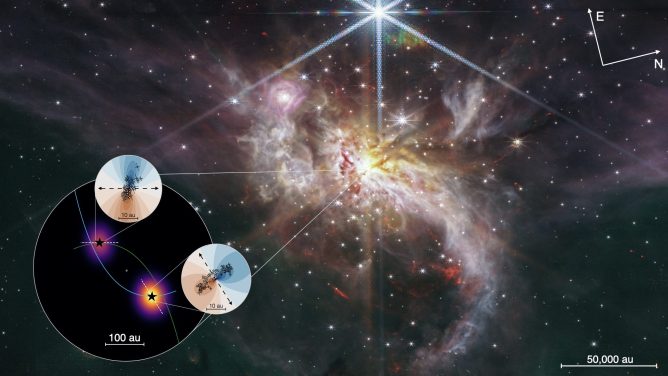
The team then studied L1527 IRS, a young star located about 450 light-years from Earth in the Taurus molecular cloud, which hosts a disk with a radius of approximately 70 astronomical units. Using the high-resolution ALMA Large Program eDisk (Embedded Disks in Planet Formation) observations, the researchers, for the first time, identified a similar jump in the radial profile of specific angular momentum at the envelope-disk transition of L1527 IRS. Spanning a radial width of about 16 astronomical units, this observed jump confirmed the existence of ENDTRANZ.
“A careful inspection and comparison of the radial dependence of specific angular momentum between the observational data and the simulations helped identify the evidence of ENDTRANZ in L1527 IRS,” said Nagayoshi Ohashi, a scientist of ASIAA and the principal investigator of the ALMA eDisk large program and another co-author of this study.
Fig 3: The young protostellar system L1527 IRS taken with NIRCam on the James Webb Space Telescope (left panel), and the observed gas motions in this system obtained by the ALMA Large Program eDisk (right panel). (a) The radial variation of the specific angular momentum and (b) rotational velocity are shown based on the blue- and red-shifted velocity components. A jump in the observed radial profile of specific angular momentum at the region highlighted in orange color is the evidence of ENDTRANZ where the gas motion transitions from the infalling-rotating envelope to the Keplerian disk. (Image Credits: (left) NASA, ESA, CSA, STScI; (right) Indrani Das/ASIAA.)
“A careful inspection and comparison of the radial dependence of specific angular momentum between the observational data and the simulations helped identify the evidence of ENDTRANZ in L1527 IRS,” said Ohashi, the principal investigator of the ALMA eDisk large program and another co-author of this study.
This pioneering work establishes ENDTRANZ as a new frontier in star and planet formation studies, opening the door to deeper exploration of its complex physics and to searching for its signatures in other young stellar systems. “In many ways, we believe this is just the beginning!” Das emphasizes.
This research was published in an article titled “Modelling the Break in the Specific Angular Momentum within the Envelope-Disk Transition Zone” by Das, I. et al. in the Astrophysical Journal on April 15, 2026, with a DOI: 10.3847/1538-4357/ae4725
Release Information
– Researcher(s) Involved in this Release:
Indrani Das, Academia Sinica Institute of Astronomy and Astrophysics (ASIAA), Taiwan
Shantanu Basu, Canadian Institute for Theoretical Astrophysics (CITA), Canada
Nagayoshi Ohashi, Academia Sinica Institute of Astronomy and Astrophysics (ASIAA), Taiwan
Eduard Vorobyov, University of Innsbruck, Austria
Yusuke Aso, Korea Astronomy and Space Science Institute (KASI), Republic of Korea
– Coordinated Release Organization(s)
Academia Sinica Institute of Astronomy and Astrophysics
Canadian Institute for Theoretical Astrophysics
University of Innsbruck
Related Link
Unveiling the Mystery of Protoplanetary Disk Formation Around Young Stars(ASIAA)
CITA, Canada
University of Innsbruck : Newsroom
The Atacama Large Millimeter/submillimeter Array (ALMA), an international astronomy facility, is a partnership of the European Organization for Astronomical Research in the Southern Hemisphere (ESO), the U.S. National Science Foundation (NSF), and the National Institutes of Natural Sciences (NINS) of Japan in cooperation with the Republic of Chile. ALMA is funded by ESO on behalf of its Member States, by NSF in cooperation with the National Research Council of Canada (NRC) and the National Science and Technology Council (NSTC) in Taiwan and by NINS in cooperation with the Academia Sinica (AS) in Taiwan and the Korea Astronomy and Space Science Institute (KASI).
ALMA construction and operations are led by ESO on behalf of its Member States; by the National Radio Astronomy Observatory (NRAO), managed by Associated Universities, Inc. (AUI), on behalf of North America; and by the National Astronomical Observatory of Japan (NAOJ) on behalf of East Asia. The Joint ALMA Observatory (JAO) provides the unified leadership and management of the construction, commissioning, and operation of ALMA.