2026.05.22
Cosmic Chaos Beats Magnetism in the Birth of Massive Star Clusters
(This article is based on the research news from Nanjing University on May 22, 2026.)
As the primary sources of heavy elements and ultraviolet radiation in galaxies, stars more than eight times the mass of the Sun play a dominant role in shaping galactic structure and evolution. Yet the mechanism that governs the formation of such massive stars in protoclusters has puzzled astronomers for decades. Traditional theories have suggested that strong magnetic fields guide gas to form density structures aligned perpendicular to the magnetic field in star-forming regions. Earlier observations of large-scale collapsing clouds and clumps have supported this picture of magnetic dominance. However, it remained unclear whether this “magnetic regulation” persists down to the small scales where individual stars and clusters actually form.
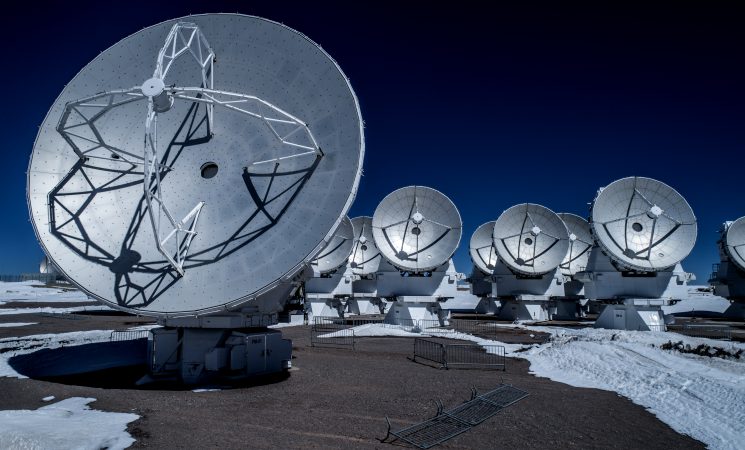
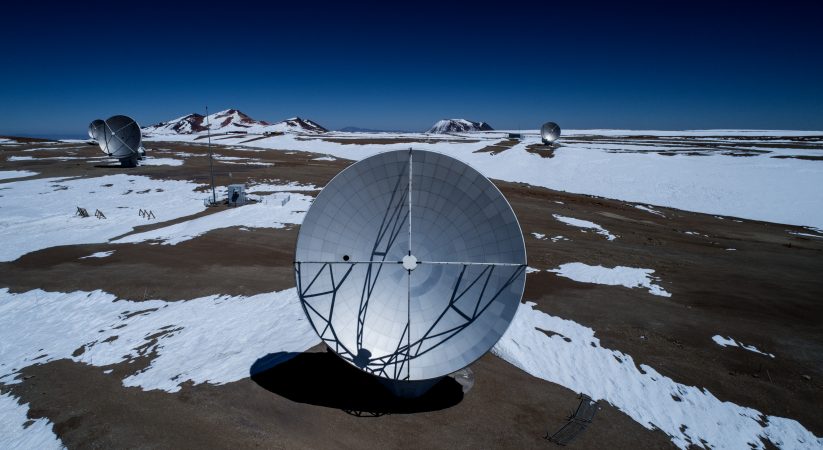
To address this, the team led by Junhao Liu at Nanjing University conducted the largest survey of magnetic fields in high-mass star-forming regions using the Atacama Large Millimeter/submillimeter Array (ALMA). By observing 30 massive star-forming regions in the Milky Way, the team for the first time obtained statistical evidence that at the small scales where individual stars begin to form, the dense gas condensations, the “seeds” of massive stars, align parallel to the local magnetic fields. This is opposite to the trend observed on larger scales. The team’s numerical simulations suggest that this parallel alignment is a distinct signature of supersonic turbulence dominating the dynamics of the gas, effectively scrambling the orderly influence of magnetism. This work also reveals a possibly turbulence-induced misalignment between magnetic fields and rotation, which allows massive protostellar disks to survive and feed the growing stars.
“Magnetic fields or turbulence? It is a cosmic battle between order and chaos. While orderly magnetic fields clearly structure giant molecular clouds and clumps on large scales, our results show they lose the battle against chaotic turbulence when it comes to forming individual stars and clusters,” said Junhao Liu, lead author of the paper and a former researcher at the National Astronomical Observatory of Japan who recently joined Nanjing University as an Assistant Professor. “This discovery shifts our understanding of massive star cluster formation from a magnetically regulated, orderly process to one driven by cosmic chaos. I expect this study not only solves an observational puzzle but will also stimulate future theoretical and simulation work to understand the detailed physical processes that form and feed these stellar seeds.”
“This work challenges classical magnetically-regulated star formation models. The breakthrough was made possible by ALMA’s unique combination of high resolution and sensitivity,” said Patricio Sanhueza, Associate Professor at the University of Tokyo and Principal Investigator of the ALMA survey. “Years of dedicated data analysis and hard work were necessary to produce these novel results. Finally, we have been able to systematically uncover the small-scale physics in massive star-forming regions. What is particularly exciting is that the small-scale behaviors of magnetic fields and turbulence are distinctly different from those observed on larger scales.”

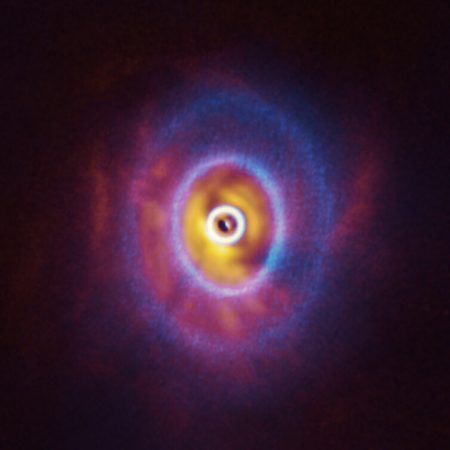
Figure 1: An example ALMA image of a massive star formation region from the survey. The background color shows the 1.3 mm dust intensity. Overlaid line patterns, generated using the line integral convolution method, indicate the magnetic field orientation. The synthesized beam of ALMA is shown as a white ellipse in the lower left corner. A scale bar of 0.05 pc is shown in the lower right corner. (Credit: Liu et al. (2026))
Figure 2: Artist impressions of the magnetic field distribution around and within the molecular cloud clumps. The 1-pc scale clump is penetrated by the magnetic field, which is ordered and perpendicular to the clump’s long axis (left panel). While at the 0.01-pc scale condensations embedded in the large clump, the magnetic field is chaotic and respectively parallel to the condensation’s long axis (right panel). (Credit: NAOJ)
This research was published in a paper titled “The dominance of turbulence over magnetism in the formation of massive star cluster seeds” by Junhao Liu et al. published in Nature Astronomy on May 22, 2026.
DOI:
This work involved 35 researchers from 29 institutions worldwide. Participating Japanese institutions include the National Astronomical Observatory of Japan, the University of Tokyo, Nagoya University, Kyoto University, and Kyushu University. International partners include Nanjing University, Academia Sinica, Center for Astrophysics | Harvard & Smithsonian, and others.
The Atacama Large Millimeter/submillimeter Array (ALMA), an international astronomy facility, is a partnership of the European Organization for Astronomical Research in the Southern Hemisphere (ESO), the U.S. National Science Foundation (NSF) and the National Institutes of Natural Sciences (NINS) of Japan in cooperation with the Republic of Chile. ALMA is funded by ESO on behalf of its Member States, by NSF in cooperation with the National Research Council of Canada (NRC) and the National Science and Technology Council (NSTC) in Taiwan and by NINS in cooperation with the Academia Sinica (AS) in Taiwan and the Korea Astronomy and Space Science Institute (KASI).
ALMA construction and operations are led by ESO on behalf of its Member States; by the National Radio Astronomy Observatory (NRAO), managed by Associated Universities, Inc. (AUI), on behalf of North America; and by the National Astronomical Observatory of Japan (NAOJ) on behalf of East Asia. The Joint ALMA Observatory (JAO) provides the unified leadership and management of the construction, commissioning, and operation of ALMA.