2026.11.18
Traces of Vaporized Minerals Found 1,350 Light-Years Away −Gaseous titanium monoxide detected around a young protostar−
(This article is based on the research news from Mizusawa VLBI Observatory, NAOJ on November 9, 2026.)
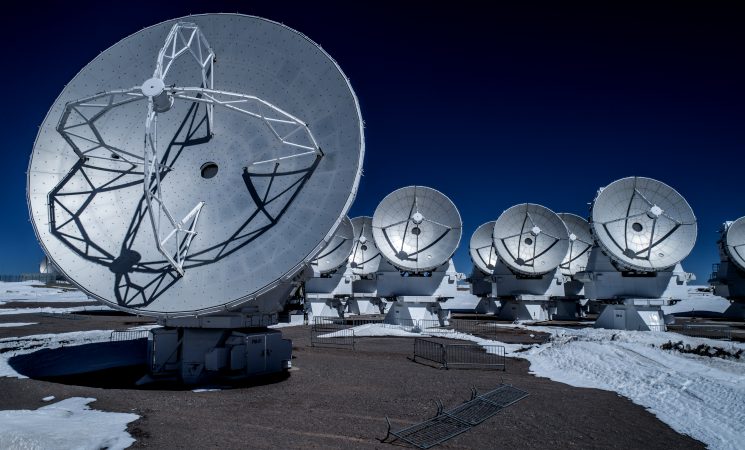
An international research team led by Ziwei E. Zhang and Nami Sakai at the RIKEN Pioneering Research Institute, and Tomoya Hirota, associate professor of Mizusawa VLBI Observatory of NAOJ, also joined in, detected titanium monoxide (TiO) around Orion Source I, a young massive protostar approximately 1,350 light-years from Earth. Using the Atacama Large Millimeter/submillimeter Array (ALMA), the researchers identified three rotational emission lines of TiO, marking the first detection of this molecule in a star-forming region.
Titanium is one of the most refractory elements: under ordinary conditions in interstellar space, it is largely locked inside solid dust grains rather than present in the gas. The newly detected TiO is therefore thought to contain titanium released from mineral-bearing dust grains in the intense heat close to the protostar.
The TiO emission is concentrated near the base of a rotating disk wind, where gas flows outward from the disk surrounding the young star. Remarkably, its distribution closely resembles that of aluminum monoxide (AlO), previously detected in the same region. Titanium and aluminum are both characteristic elements of calcium–aluminum-rich inclusions (CAIs), the oldest known solid materials formed in the Solar System.
The findings provide compelling observational evidence that refractory minerals can vaporize in the environments where stars are forming. They also open a new way to investigate the high-temperature processing of solids that may have contributed to the formation of CAI-like materials in the early Solar System.
This study was published in the online edition of The Astrophysical Journal Letters on October 23. See the news article from Mizusawa VLBI Observatory.
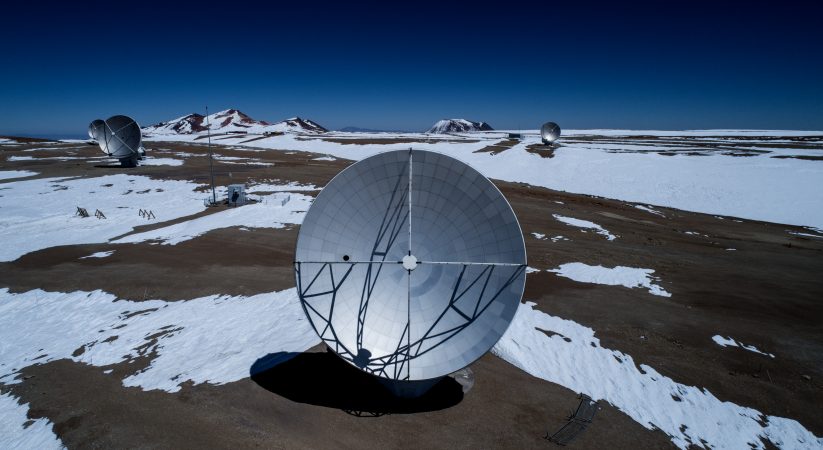
Detecting TiO spectral lines required observations at some of the highest frequencies accessible to ALMA in the millimeter and submillimeter wavelength ranges. In particular, the Band 10 receiver, which operates at frequencies closest to the infrared and represents ALMA’s highest-frequency observing band, was developed with a leading contribution from a research team at NAOJ. (Related article: NAOJ successfully developed the Band 10 receiver -Press release on 2009.06.16)

Illustration of the disk, disk wind, and refractory molecules around Orion Source I. A schematic illustration of the massive protostar Orion Source I and its surrounding disk (blue). Gas containing silicon monoxide (SiO; orange) flows outward from the disk in a rotating wind. Titanium monoxide (TiO; red) is detected near the base of this wind, where high temperatures may vaporize refractory minerals. The illustration is not to scale. (Provided by RIKEN)
Related Link
•Traces of Vaporized Minerals Found 1,350 Light-Years Away −Gaseous titanium monoxide detected around a young protostar− (Reports on 2026.11.9, Mizusawa VLBI Observatory, NAOJ)
•Traces of Vaporized Minerals Found 1,350 Light-Years Away −Gaseous titanium monoxide detected around a young protostar− (Press Release on 2026.11.5, RIKEN)
About ALMA
The Atacama Large Millimeter/submillimeter Array (ALMA), an international astronomy facility, is a partnership of the European Organization for Astronomical Research in the Southern Hemisphere (ESO), the U.S. National Science Foundation (NSF) and the National Institutes of Natural Sciences (NINS) of Japan in cooperation with the Republic of Chile. ALMA is funded by ESO on behalf of its Member States, by NSF in cooperation with the National Research Council of Canada (NRC) and the National Science and Technology Council (NSTC) in Taiwan and by NINS in cooperation with the Academia Sinica (AS) in Taiwan and the Korea Astronomy and Space Science Institute (KASI).
ALMA construction and operations are led by ESO on behalf of its Member States; by the National Radio Astronomy Observatory (NRAO), managed by Associated Universities, Inc. (AUI), on behalf of North America; and by the National Astronomical Observatory of Japan (NAOJ) on behalf of East Asia. The Joint ALMA Observatory (JAO) provides the unified leadership and management of the construction, commissioning, and operation of ALMA.