2026.11.26
Footprints of High-Velocity Jets in a Molecular Cloud Suggest Powerful Cosmic-Ray Acceleration Driven by a Black Hole
(This article is based on a press release issued by Nagoya University on November 25, 2026.)
How cosmic rays, high-energy particles traveling through the Universe, are accelerated remains one of the most important questions in astrophysics. One of the leading candidates for producing extremely energetic cosmic rays is a microquasar, an object in which gas accretes to a black hole or neutron star from a companion star and launches jets moving at nearly the speed of light. However, only about twenty microquasars have been identified so far, and their detection difficulty has posed a major obstacle to promoting further study.
A research team led by Yasuo Fukui, Professor Emeritus at Nagoya University; Kisetsu Tsuge, Assistant Professor at Gifu University; Hidetoshi Sano, Associate Professor at Gifu University; and Bhuvana Gadikere Rajendra, Postdoctoral Researcher at Gifu University, collaborated with the H.E.S.S. gamma-ray observatory team and a research team for theoretical simulation. Using ALMA, they observed molecular clouds around the Galactic gamma-ray source HESS J1023−575 (hereafter HESS J1023) and identified molecular cloud structures that appear to have formed when jets compressed the surrounding atomic hydrogen gas.

Figure 1:(Top left) Molecular clouds around the gamma-ray source HESS J1023−575, marked by the star symbol. Enlarged ALMA views of the Jet-like cloud (bottom left) and the Arc-like cloud (right) reveal numerous thin filamentary structures. These features are thought to be footprints left by past interaction between the microquasar jet and the interstellar medium. (Credit: Adapted from Fig. 1 of Fukui et al. (2026), PASJ.)
The team, which has long studied the distribution of star-forming molecular clouds using facilities including the NANTEN radio telescope operated by Nagoya University in Chile, discovered an unusual linear arrangement of jet-like and arc-like molecular clouds centered on HESS J1023 in 2009. Interpreting these clouds as products of high-energy jet activity, the researchers carried out magnetohydrodynamic (MHD) simulations and demonstrated that jets can create molecular clouds from the surrounding atomic gas. Subsequent observations with H.E.S.S. improved the sensitivity of TeV gamma-ray data and revealed gamma-ray emission aligned with the jet-like molecular cloud. This spatial correspondence between the molecular cloud and gamma-ray emission provides an important clue linking jet activity to high-energy phenomena.
The team then used ALMA to observe the entire molecular cloud complex associated with HESS J1023 at ten times higher spatial resolution than previous observations. For the first time, they revealed that the cloud consists of numerous linear filaments approximately 1.5 light-years wide and 30-60 light-years long. MHD simulations well reproduce the process of how jets compress atomic hydrogen gas to form molecular clouds, creating structures whose characteristic widths correspond to the jet diameter. The morphology and spacing of the filaments observed with ALMA closely match the simulation results, providing the first detailed view of the “footprints” left behind by jet activity in molecular clouds.
Figure 2: Schematic illustration of how jet activity forms molecular gas structures. Jets launched from a black hole or neutron star accreting material from a companion star (a microquasar) are thought to compress the surrounding atomic hydrogen gas, causing it to form molecular gas and produce filamentary structures with widths comparable to those of the jets. (Credit: NAOJ)
Traditionally, supernova remnants are regarded as the most likely sources of Galactic cosmic rays. However, joint analysis with the H.E.S.S. team indicates that the energy of cosmic-ray protons associated with HESS J1023 is approximately 7 × 10^48 erg, about ten times greater than that of a young supernova remnant. In addition, simulations suggest that the jet activity persisted for roughly ten million years, more than a thousand times longer than the lifetime of a supernova remnant. These findings indicate that HESS J1023 may be the most powerful cosmic-ray accelerator in the Galactic disk, far exceeding the capability of supernova remnants.
The linear filaments and arc-like structures in molecular clouds, as found in this study, provide a new signpost to search for previously overlooked microquasar candidates. Even after the jets themselves have faded, molecular clouds formed by their activity can remain as “cosmic fossils,” preserving evidence of past black-hole activity. The team plans to survey additional candidates through large-scale molecular cloud surveys, followed by high-resolution ALMA observations to measure the widths, spacing, temperatures, and motions of the filaments in detail. By combining with simulations and gamma-ray observations, they aim to determine how much microquasars contribute to the origin of cosmic rays.
Publication
This research was published online in Publications of the Astronomical Society of Japan (PASJ) Letters on 13 November 2026 as: Fukui et al., “An ALMA view of the jet–arc CO clouds toward the TeV γ-ray source HESS J1023−575 and Westerlund 2: Evidence for the footprints of microquasar jets, the very powerful cosmic ray accelerator in the Galactic disk.”
DOI: 10.1093/pasj/psag136
Researchers Involved in this release
– Yasuo Fukui (Professor Emeritus, Graduate School of Science, Nagoya University)
– Kisetsu Tsuge (Designated Assistant Professor, Institute for Advanced Study, Gifu University / Designated Researcher, Institute for Advanced Research, Nagoya University)
About ALMA
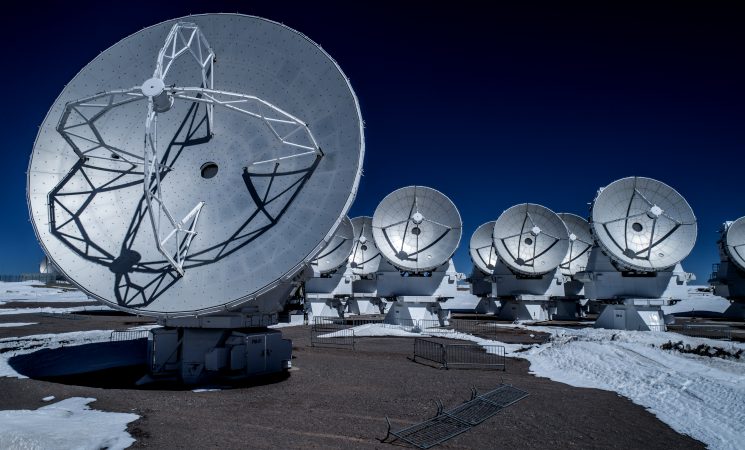
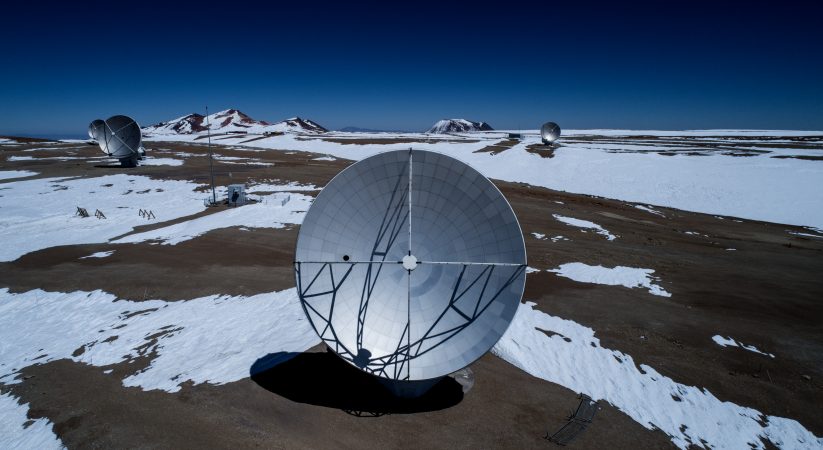
The Atacama Large Millimeter/submillimeter Array (ALMA), an international astronomy facility, is a partnership of the European Organization for Astronomical Research in the Southern Hemisphere (ESO), the U.S. National Science Foundation (NSF) and the National Institutes of Natural Sciences (NINS) of Japan in cooperation with the Republic of Chile. ALMA is funded by ESO on behalf of its Member States, by NSF in cooperation with the National Research Council of Canada (NRC) and the National Science and Technology Council (NSTC) in Taiwan and by NINS in cooperation with the Academia Sinica (AS) in Taiwan and the Korea Astronomy and Space Science Institute (KASI).
ALMA construction and operations are led by ESO on behalf of its Member States; by the National Radio Astronomy Observatory (NRAO), managed by Associated Universities, Inc. (AUI), on behalf of North America; and by the National Astronomical Observatory of Japan (NAOJ) on behalf of East Asia. The Joint ALMA Observatory (JAO) provides the unified leadership and management of the construction, commissioning, and operation of ALMA.