2026.03.19
Streamline feeding of a baby massive star
(This article is based on the research news from Kyoto University on August 21, 2025.)
High mass stars (around 10 times the mass of the Sun) drive some of the most energetic phenomena in the Universe as they end their lives as supernovae. These explosions help shape the evolution of galaxies and enrich the interstellar medium with heavier elements more efficiently than a typical solar-type star. High mass stars also emit intense radiation that can blow away and ionize the surrounding gas, shaping star formation in their neighborhood.
Despite their importance, the formation of high-mass stars remains a major open question. Their birthplaces lie deep inside dense clouds of gas and dust, and usually much farther from Earth than the regions where Sun-like stars form. As a young massive star begins heating its surrounding cocoon, molecules evaporate from dust grains and emit radio waves, while the dust itself absorbs the stellar light and re-emits it at similar wavelengths. With its high angular resolution and ability to observe at radio wavelengths, ALMA provides a unique window into this hidden environment—allowing researchers to trace how gas moves and how it is distributed around a forming star
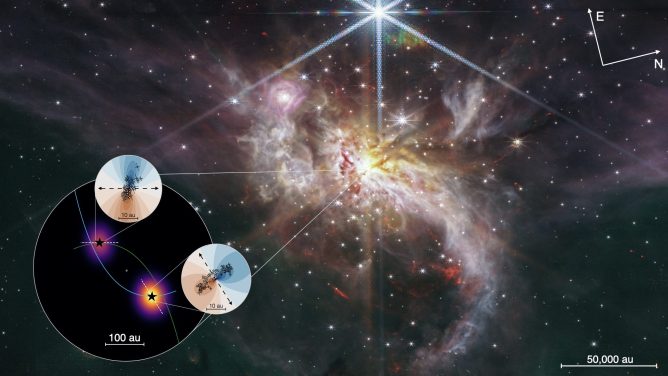
Using ALMA’s advanced capabilities, researchers from Kyoto University and the University of Tokyo, leading an international collaboration, observed the Galactic star‑forming cloud G336.01−0.82 with one of ALMA’s most extended antenna configurations. Their goal was to trace emission from dust and methanol (CH₃OH). Earlier observations had revealed a couple of gas streams carrying material from the surrounding cocoon — from distances of up to 2000 astronomical units (au) down to about 500 au from the central source. These streams were previously thought to feed a relatively large disk. However, the latest, higher‑resolution observations reveal a different picture within the inner 500 au.
The dust emission shows that the gas streams persist all the way to the vicinity of the young star, while an overdense region around it may correspond to a small disk. “We found through the gas motion seen in methanol, that these massive streamers bring fresh gas to sustain the overdense region,” says Fernando Olguin, the leading researcher. This overdense structure helps channel the powerful stellar radiation through the polar regions, allowing the baby star to keep feeding from the infalling gas. “This source shows a different way to feed young high-mass stars without the need for larger disks,” he adds.
The team will now focus on identifying similar systems among the large number of sources observed with ALMA. Studies of low‑mass protostellar cocoons have shown that many streamers are only revealed through their molecular gas emission. The team therefore hopes to uncover more such structures by examining the kinematics of the circumstellar gas. This approach will help researchers determine the different ways in which young massive stars are fed.

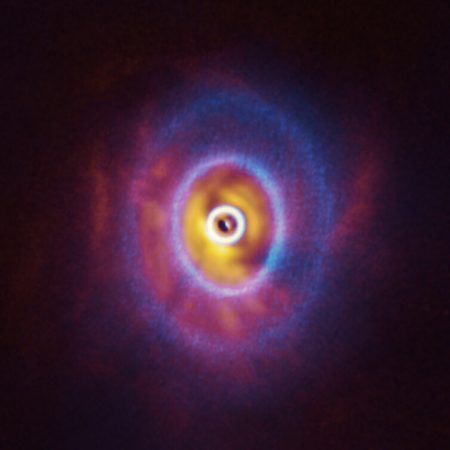
Artist’s impression of spiral gas streamers feeding a forming high-mass star. (Credit: NAOJ)
This research was published in a paper titled “Massive extended streamers feed high-mass young stars” by Olguin et al. in Science Advances on August 20, 2025. DOI: 10.1126/sciadv.adw4512
This work is supported by the NAOJ ALMA Joint Scientific Research Program grant no. 2024-27B, and other Japanese and overseas grant programs.
Related link
Feeding massive stars – (Kyoto University RESEARCH NEWS)
The Atacama Large Millimeter/submillimeter Array (ALMA), an international astronomy facility, is a partnership of the European Organization for Astronomical Research in the Southern Hemisphere (ESO), the U.S. National Science Foundation (NSF) and the National Institutes of Natural Sciences (NINS) of Japan in cooperation with the Republic of Chile. ALMA is funded by ESO on behalf of its Member States, by NSF in cooperation with the National Research Council of Canada (NRC) and the National Science and Technology Council (NSTC) in Taiwan and by NINS in cooperation with the Academia Sinica (AS) in Taiwan and the Korea Astronomy and Space Science Institute (KASI).
ALMA construction and operations are led by ESO on behalf of its Member States; by the National Radio Astronomy Observatory (NRAO), managed by Associated Universities, Inc. (AUI), on behalf of North America; and by the National Astronomical Observatory of Japan (NAOJ) on behalf of East Asia. The Joint ALMA Observatory (JAO) provides the unified leadership and management of the construction, commissioning, and operation of ALMA.