2026.04.07
ALMA Reveals Magnetically Driven Disk Wind in the Protostar
(This result is based on the press release from Seoul National University on April 6, 2026.)
Stars and planets form from rotating disks of gas and dust, but astronomers have long struggled to understand how these disks lose angular momentum — a key process that allows material to fall inward and form stars.
Using high-resolution observations with the Atacama Large Millimeter/Submillimeter Array (ALMA), an international team led by Chul-Hwan Kim and Jeong-Eun Lee at Seoul National University studied the very young protostar and discovered clear evidence that a “magnetically driven disk wind” is removing angular momentum from the disk.
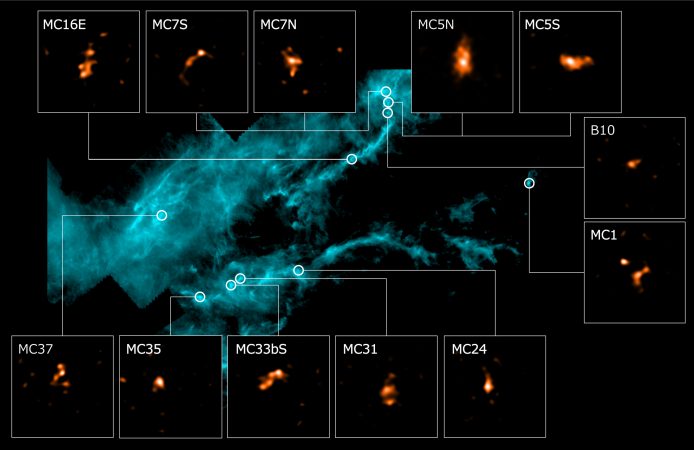
The research team focuses on HOPS 358, a deeply embedded Class 0 protostar located about 1300 light-years away in the Orion B molecular cloud. At this early stage, the star is still actively accreting material from a surrounding disk. For accretion to proceed, the disk must shed angular momentum—but how this happens has remained one of the central questions in star formation.
The team mapped the motions of several molecular species that trace gases near the protostar. The data reveal a key signature: the outflowing gas rotates in the same direction as the disk itself. If the outflow were produced by shocks or by interaction with a high-speed jet, the gas would not necessarily preserve the disk’s rotation. Instead, the observed kinematics demonstrate that the gas is launched directly from the rotating disk, forming a disk wind.
The observations further reveal a nested, layered structure in the outflow. Different molecules trace distinct regions: SO is concentrated close to the outflow axis, CH₃OH traces intermediate layers, and H₂CO extends farther outward. This stratified morphology closely matches theoretical predictions for disk winds launched over a wide range of disk radii.
Recent observations with the James Webb Space Telescope (JWST) have also imaged nested outflow structures in young stellar systems, but JWST cannot determine whether the outflows are rotating or directly linked to the disk. ALMA’s high spectral resolution enables precise kinematic measurements, providing the missing dynamical evidence needed to identify the physical origin of the flow.
To further test the nature of the outflow, the researchers analyzed a key diagnostic known as the magnetic lever arm parameter. In simple terms, magnetic field lines anchored in the rotating disk act like a rotating lever or sling, accelerating gas outward. This parameter quantifies how efficiently magnetic fields extract angular momentum from the disk. If the outflow is driven primarily by magnetic forces, the value is significantly larger than unity.
For HOPS 358, the team measured a value of approximately λ ≈ 2.3, well above the threshold expected for magnetically driven winds. This provides strong evidence that the observed outflows are powered by MHD disk winds.
The study also shows that the wind is launched from radii of about 10–18 astronomical units, within the region where planets are expected to form. This implies that disk winds may play a key role in shaping the physical and chemical conditions of planet-forming disks from the earliest stages.
Together, these results demonstrate that MHD disk winds, which remove angular momentum and enable accretion, are actively regulating disk evolution during the early phase of star formation, to determine how stars grow and how the initial conditions for planet formation are established.

Figure 1: Velocity distribution maps of different molecular emission lines in the protostar HOPS 358 observed with ALMA. The gas traced by ¹³CO reveals a rotating disk, while CH₃OH, SO, and H₂CO trace a disk wind launched from the disk, highlighting distinct layers of the outflow. The orange solid line in each panel indicates the outflow axis of HOPS 358 reported in previous studies. The gray contours show the dust continuum emission. The velocity structures of these molecular lines are illustrated in blue and red, indicating gas moving toward and away from us. They indicate that the disk wind rotates in the same direction as the disk. (Credit: Kim et al., ALMA (ESO/NAOJ/NRAO))
Figure 2. Schematic illustration of the gas structures around the protostar HOPS 358 inferred from ALMA observations. The gas traced by ¹³CO reveals a rotating disk, while H₂CO, CH₃OH, and SO trace a layered disk wind launched from the disk. The distinct spatial distributions of these molecules provide important clues to the structure and physical conditions of the disk wind.(Credit: Kim et al., ALMA (ESO/NAOJ/NRAO))
This research was published in a paper titled “Direct evidence of magnetized disk winds driving rotating outflows in protostar HOPS 358” by Chul-Hwan Kim et al. published in Nature Communications on April 6, 2026.
DOI:10.1038/s41467-026-71142-3
This work was supported by the National Research Foundation of Korea (NRF) grant funded by the Korean government (MSIT; grant number 2021R1A2C1011718 and RS-2024-00416859 to J.-E.L. and C.-H.K.). D.J. is supported by NRC Canada and by an NSERC Discovery Grant. G.J.H. is supported by grant IS23020 from the Beijing Natural Science Foundation. C.-F. L. acknowledges a grant from the National Science and Technology Council of Taiwan (112-2112- M-001-039-MY3).
This paper makes use of the following ALMA data: ADS/-JAO.ALMA#2023.1.01245.S.
Related Link:
https://www.doi.org/10.1038/s41467-026-71142-3
Research Highlights: Direct evidence for magnetohydrodynamic disk winds driving rotating outflows in protostar HOPS 358
The Atacama Large Millimeter/submillimeter Array (ALMA), an international astronomy facility, is a partnership of the European Organization for Astronomical Research in the Southern Hemisphere (ESO), the U.S. National Science Foundation (NSF) and the National Institutes of Natural Sciences (NINS) of Japan in cooperation with the Republic of Chile. ALMA is funded by ESO on behalf of its Member States, by NSF in cooperation with the National Research Council of Canada (NRC) and the National Science and Technology Council (NSTC) in Taiwan and by NINS in cooperation with the Academia Sinica (AS) in Taiwan and the Korea Astronomy and Space Science Institute (KASI).
ALMA construction and operations are led by ESO on behalf of its Member States; by the National Radio Astronomy Observatory (NRAO), managed by Associated Universities, Inc. (AUI), on behalf of North America; and by the National Astronomical Observatory of Japan (NAOJ) on behalf of East Asia. The Joint ALMA Observatory (JAO) provides the unified leadership and management of the construction, commissioning, and operation of ALMA.